


Flanges are essential components in piping systems, providing reliable connections between pipes, valves, pumps, and other equipment. They allow piping components to be assembled, inspected, maintained, and replaced when necessary.
However, different flange types are designed for different operating conditions. Selecting the right flange depends on factors such as pressure, temperature, fluid characteristics, installation requirements, and applicable piping standards.
In this guide, we will introduce seven commonly used flange types, including their names, standard abbreviations, structural characteristics, and typical applications.
Whether you are a piping engineer, procurement specialist, or industrial equipment buyer, understanding these flange types will help you make more informed decisions.
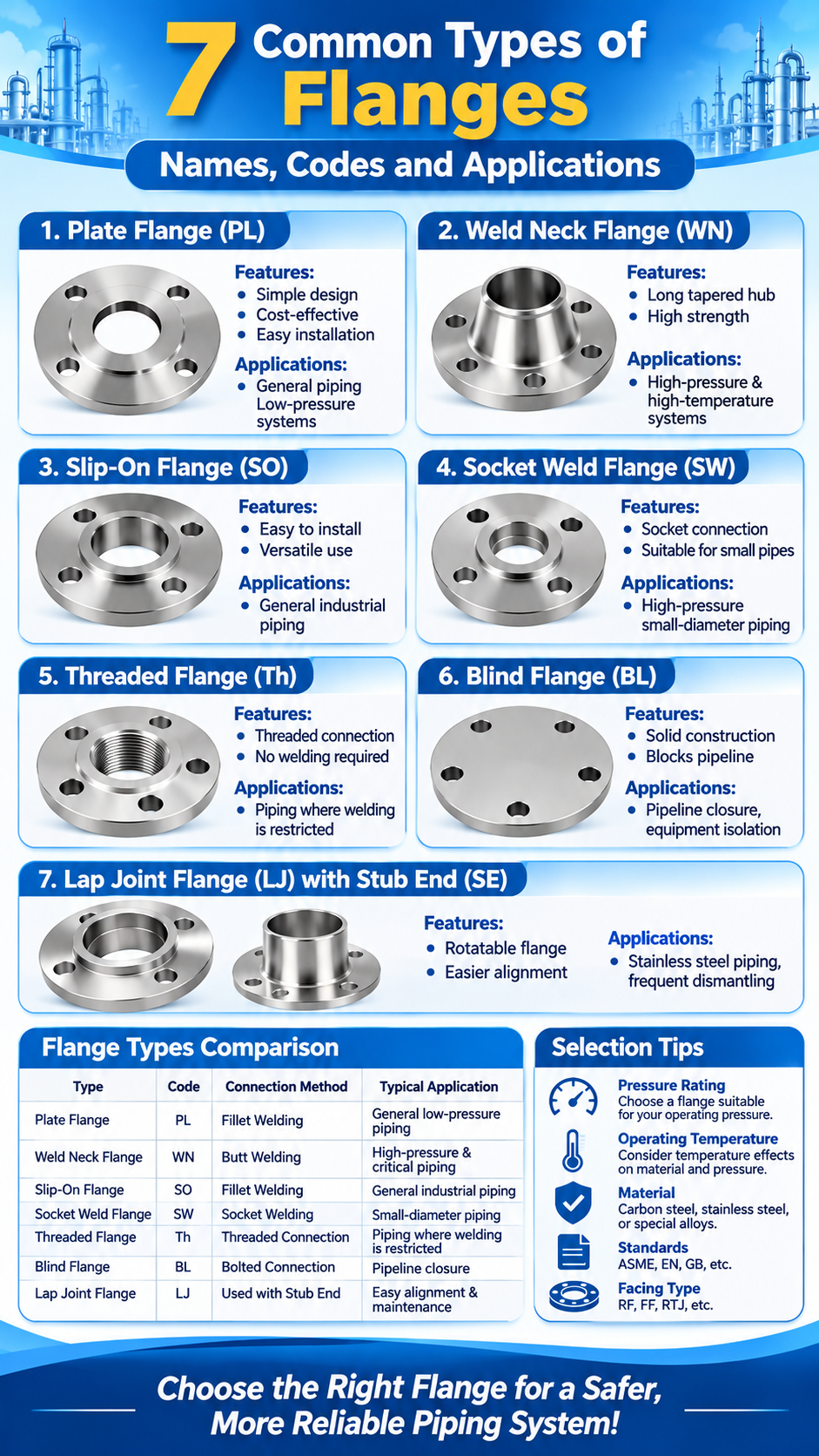
1. Plate Flange (PL)
Common Name: Plate Flange
Abbreviation: PL
Alternative Name: Flat Flange
A plate flange is a flat, circular flange with a central bore and bolt holes. It is typically connected to a pipe by fillet welding.
Due to its simple structure and economical manufacturing process, the plate flange is widely used in general industrial piping systems.
Key Features
Simple and compact design
Economical manufacturing cost
Easy installation and welding
Suitable for various general-purpose piping applications
Typical Applications
Water supply and drainage systems
HVAC piping
General industrial pipelines
Low-pressure piping systems
Selection Tip: Plate flanges are often selected for economical piping solutions. However, their suitability must be evaluated based on the required pressure rating, temperature, and applicable design standards.
2. Weld Neck Flange (WN)
Common Name: Weld Neck Flange
Abbreviation: WN
A weld neck flange features a long, tapered hub that is butt-welded to the pipe. Its design helps distribute stress more evenly between the flange and the connected piping.
Weld neck flanges are widely used in demanding industrial applications where mechanical strength and reliability are important.
Key Features
Long tapered hub
Butt-weld connection
Good resistance to mechanical stress
Suitable for demanding pressure and temperature conditions
Typical Applications
Oil and gas pipelines
Petrochemical plants
High-pressure piping systems
High-temperature and low-temperature applications
Critical process piping
Selection Tip: Weld neck flanges are commonly preferred for demanding operating conditions. Proper material selection, welding procedures, and dimensional compatibility are essential for reliable performance.
3. Slip-On Flange (SO)
Common Name: Slip-On Flange
Abbreviation: SO
A slip-on flange is designed to slide over the pipe before being welded in place. It is generally connected using fillet welds on both the inside and outside.
Compared with weld neck flanges, slip-on flanges are relatively easy to install and are often used in general industrial piping systems.
Key Features
Easy to align and install
Relatively simple welding process
Lower fabrication requirements
Suitable for many general-purpose applications
Typical Applications
Water treatment systems
General industrial piping
Utility pipelines
Moderate-pressure piping systems
Selection Tip: Slip-on flanges may be suitable for applications where installation efficiency and cost are important. Their pressure and temperature limitations should be checked against the applicable piping code.
4. Socket Weld Flange (SW)
Common Name: Socket Weld Flange
Abbreviation: SW
A socket weld flange has a recessed socket into which the pipe is inserted before welding.
The connection is made using a fillet weld around the outside of the pipe. This design is particularly suitable for small-diameter piping systems.
Key Features
Socket connection design
Convenient installation for small pipes
Suitable for specific high-pressure applications
No butt-welding preparation required at the pipe end
Typical Applications
Small-diameter industrial pipelines
Instrumentation piping
Chemical processing systems
High-pressure utility lines
Selection Tip: Socket weld flanges are commonly used for small-bore piping. For cyclic service or applications involving fatigue, additional consideration should be given to the socket geometry and applicable code requirements.
5. Threaded Flange (Th)
Common Name: Threaded Flange
Abbreviation: Th
Alternative Name: Screwed Flange
A threaded flange features internal threads that connect directly to the external threads of a pipe.
Unlike welded flange types, threaded flanges do not require welding for the pipe connection, making them useful in applications where welding is restricted.
Key Features
Threaded connection
No welding required for the pipe connection
Convenient installation and maintenance
Suitable for specific small-diameter piping systems
Typical Applications
Small-bore piping
Utility pipelines
Areas where welding is restricted
Certain hazardous-area installations
Selection Tip: Threaded flanges require careful consideration of thread standards, sealing methods, pressure, and temperature. They are not suitable for every high-pressure or high-temperature application.
6. Blind Flange (BL)
Common Name: Blind Flange
Abbreviation: BL
Alternative Name: Blind Flange Plate
A blind flange is a solid flange without a central bore. It is used to close the end of a pipeline, pressure vessel, or equipment nozzle.
Blind flanges can be removed when access to the piping system is required.
Key Features
Solid construction
No central opening
Suitable for pipeline isolation
Can be used for temporary or permanent closure
Typical Applications
Pipeline end closures
Pressure vessel openings
Equipment nozzles
Pipeline maintenance and testing
Future pipeline extensions
Selection Tip: Blind flanges are subject to significant pressure-induced forces. Their thickness, pressure rating, material, and sealing surface must be selected according to the applicable design requirements.
7. Lap Joint Flange (LJ)
Common Name: Lap Joint Flange
Abbreviation: LJ
Related Component: Stub End (SE)
A lap joint flange is typically used together with a stub end. The stub end is welded to the pipe, while the loose flange fits over the stub end and can rotate freely.
This design makes bolt-hole alignment easier during installation.
Key Features
Rotatable flange design
Easier bolt-hole alignment
Convenient installation and maintenance
Suitable for specific corrosion-resistant piping systems
Typical Applications
Stainless steel piping systems
Piping requiring frequent dismantling
Corrosion-resistant process piping
Applications where installation alignment is important
Selection Tip: Lap joint flanges are commonly used with stub ends. The materials of the flange and stub end may differ, depending on the design and corrosion requirements
Flange Types Comparison Table
The following table summarizes the common flange types and their typical applications.
| Flange Type | Code | Connection Method | Typical Application |
|---|---|---|---|
| Plate Flange | PL | Fillet Welding | General low-pressure piping |
| Weld Neck Flange | WN | Butt Welding | High-pressure and critical piping |
| Slip-On Flange | SO | Fillet Welding | General industrial piping |
| Socket Weld Flange | SW | Socket and Fillet Welding | Small-diameter piping |
| Threaded Flange | Th | Threaded Connection | Piping where welding is restricted |
| Blind Flange | BL | Bolted Connection | Pipeline closure |
| Lap Joint Flange | LJ | Used with Stub End | Easy alignment and maintenance |
Note: Flange abbreviations may vary depending on the applicable standard, specification, or manufacturer. Always verify the flange designation against the relevant technical documentation.
How to Select the Right Flange for Your Piping System
Choosing the correct flange requires more than identifying its type. Several technical factors should be considered.
1. Pressure Rating
The flange must be suitable for the operating pressure of the piping system.
Common pressure designation systems include:
PN ratings, such as PN10, PN16, PN25, and PN40
ASME Class ratings, such as Class 150, Class 300, and Class 600
PN and Class ratings are different designation systems and should not be treated as directly interchangeable.
2. Operating Temperature
Temperature affects the pressure capacity and mechanical properties of flange materials.
For example, a flange suitable for ambient-temperature service may require a different pressure rating at elevated temperatures.
3. Material Selection
Common flange materials include:
Carbon Steel: A105, A105N, Q235B
Stainless Steel: 304, 316L
Alloy Steel: F11, F22
Other materials specified for particular applications
Material selection should consider corrosion resistance, mechanical properties, operating temperature, and the requirements of the applicable material specification.
4. Flange Standard
Flanges are manufactured according to different international standards.
Common standards include:
ASME
DIN
GOST
JIS
GB
Different standards may specify different dimensions, pressure ratings, facing types, and tolerances.
5. Facing Type
The flange facing is an important factor in achieving reliable sealing.
Common flange facing types include:
RF – Raised Face
FF – Flat Face
RTJ – Ring Type Joint
The appropriate facing depends on the flange standard, gasket type, pressure, temperature, and sealing requirements.
Frequently Asked Questions (FAQ)
What are the most common types of flanges?
The most commonly used flange types include plate flanges, weld neck flanges, slip-on flanges, socket weld flanges, threaded flanges, blind flanges, and lap joint flanges.
Each type has different structural characteristics and application requirements.
What is the difference between WN and SO flanges?
A weld neck flange is connected to the pipe by butt welding and features a tapered hub.
A slip-on flange slides over the pipe and is generally connected by fillet welding.
Weld neck flanges are commonly used in more demanding piping applications, while slip-on flanges are often selected for general-purpose systems.
What is the difference between a blind flange and a regular flange?
A blind flange has no central bore and is used to close a pipeline or equipment opening.
Other flange types typically have a central bore that allows fluid to flow through the connected piping system.
Which flange is best for high-pressure applications?
Weld neck flanges are commonly used in high-pressure applications because of their structural design and butt-weld connection.
However, the appropriate flange type depends on the design code, pressure-temperature rating, material, and operating conditions.
What is the difference between PL and SO flanges?
PL generally refers to a plate flange, while SO refers to a slip-on flange.
A plate flange is typically a flat plate design, whereas a slip-on flange has a hub and slides over the pipe before welding.
The exact designation should be confirmed against the applicable flange standard.
Conclusion
Understanding flange types, codes, and applications is essential for selecting the right components for industrial piping systems.
From economical plate flanges to weld neck flanges for demanding operating conditions, each flange type serves a specific purpose.
By considering pressure, temperature, material, connection method, and applicable standards, engineers and procurement professionals can select suitable flange solutions for their projects.
At SFT(WENZHOU SAFETY STAINLESS STEEL CO.,LTD), we specialize in the manufacturing and supply of industrial flanges, stainless steel valves, and pipe fittings for a wide range of applications.
Contact us to discuss your flange requirements, technical specifications, and customized manufacturing needs.
We look forward to supporting your next project with reliable piping components.

